
Context is What Makes the System Irreplaceable
A conversation with Chaitanya Asawa, Founding Engineer at Glean

Context isn’t just the documents that an organization has, it’s everything around how those documents and the people at the organization interact. Who makes decisions? Who approves what flows? How are exceptions handled? Who is the DRI? Foundation recently wrote a great piece in which they define this as an organization’s “context graph”. We’re also seeing a lot of effort in the developer ecosystem as teams grapple with how to preserve context when building agents inside large, fast-moving codebases.
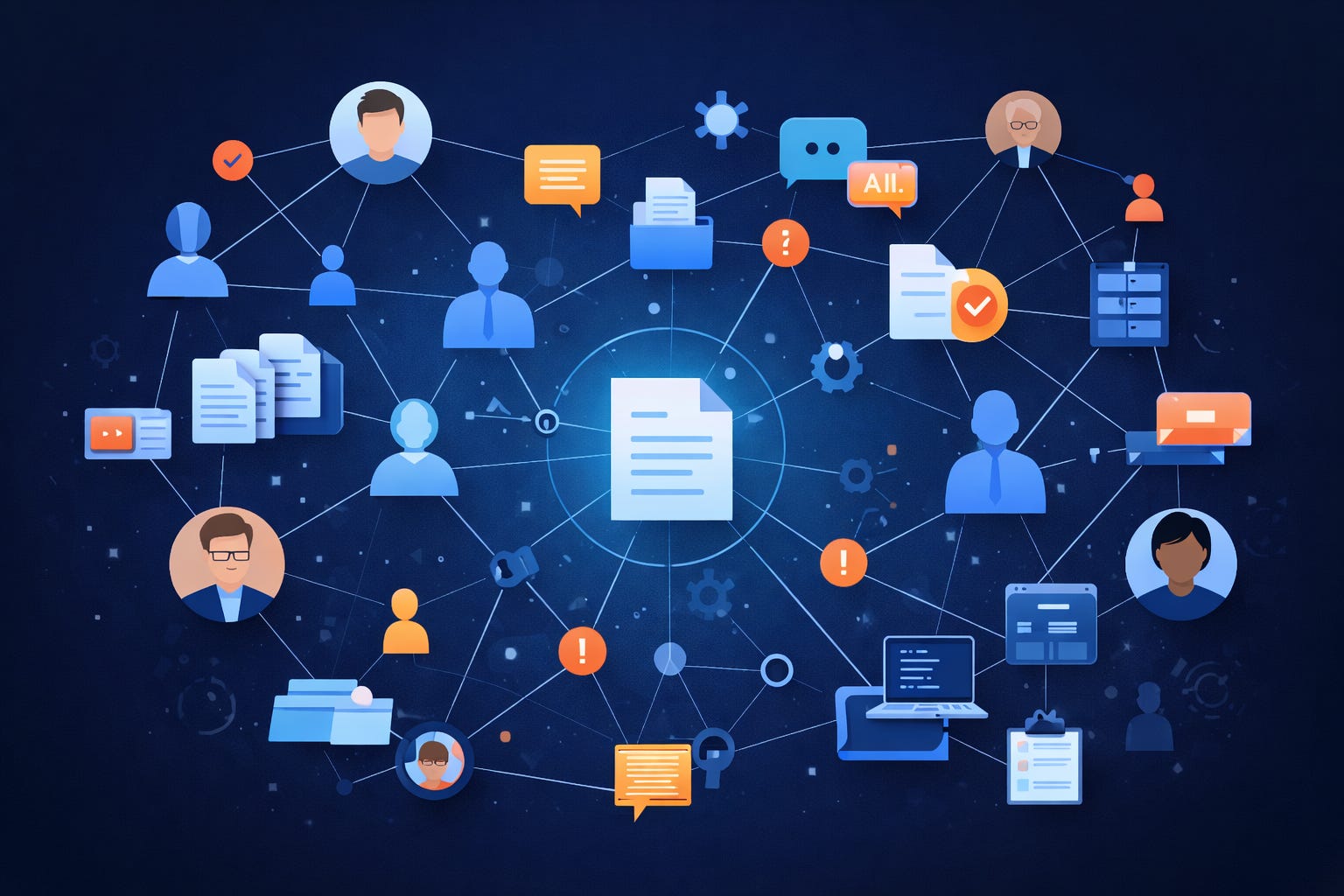
Solving the context gap is a critical part of building enterprise AI products. It’s how products learn bespoke workflows and, eventually, earn the trust needed for agents to take action.
Glean is one of the best examples of a company that prioritized context from day one, which helps explain how it became one of the leaders in enterprise AI today. Chaitanya (Chai) Asawa is a close friend and was one of the founding engineers at Glean. After an over 6 year run, he recently stepped down to lead engineering for clinical decision support at Abridge. But before he left, we caught up to talk about his time at Glean, what he learned while building the company, and why context was so important in their story.
From Enterprise Search to the Work Assistant
In 2021, when I first asked Chai why he bet on a tiny startup that had nothing, I remember him telling me that in our personal lives, information feels effortless. You can ask Google almost anything and get an answer instantly. But at work, that’s not the case. Information is fragmented across email, docs, Slack, CRMs, internal tools, and wikis that no one trusts to be current. Glean was on a mission to solve this and Chai believed deeply in that mission. Fast forward to today and, for the most part, they’ve achieved that mission.
“Glean believed search was one of the most powerful technologies ever built, and workplace search was broken,” Chai says. In the early days, Glean looked like a classic enterprise search product. Users could type a query and get relevant links.
In building this early search product, Glean was aggregating all of an organization’s data. It connected to nearly every system inside a company and was building a living map of how information moved through the organization.
As AI matured and the ChatGPT moment happened in 2022, that foundation turned out to be crucial. Glean now had all the context it needed from building out enterprise search, and could start to move toward something that looked more like a work assistant. Answering questions directly, grounded in company data, and supporting execution inside workflows.
Context Beats Model Power
Since Glean doesn’t build its own foundation models, its advantage isn’t that it has better models. It’s that it has a deeper understanding of how an organization behaves. It has the content, but also all the context around that content. “The hardest part isn’t just matching keywords. Users typed two to three word queries, there’s not much there,” Chai told me. “It’s understanding all the signals to get the intent behind the question inside that organization.”
In large organizations, the same request can mean different things depending on role, location, team, etc. The “right” answer might differ depending on location, e.g. the SF office policies vs the NY office ones. Two companies in the same industry can run the “same” workflow in completely different ways.
“We understand everything about the company; the people, who works with who, recent activity. And that context changes what the right answer actually is.” Chai said.
Because Glean connects to nearly every system inside an enterprise, it builds deep organizational context for each customer. It has the data on what decisions were made, and also the history of how those decisions were made.
These signals form continuous feedback loops that allow the product to improve automatically and become more tailored to each organization over time. These loops also allow the system to adapt to a specific role at a specific moment in a specific company. Over time, this becomes harder and harder for other companies to replicate.
The Horizontal vs. Vertical Tension
Glean is a horizontal company meaning that its products are industry-agnostic and role-agnostic. It sells the same core product across biotech, fintech, manufacturing, tech, among others – and its users span nearly every department across those industries. Vertical companies, by contrast, go deep in a specific industry or persona and build tightly around those workflows.
Horizontal companies typically struggle with depth. It’s hard to cover every workflow and edge case. Whereas vertical companies tend to go very deep in a certain industry, but that inherently narrows the market and buyer pool. This tradeoff around breadth vs depth is important for deciding how context gets acquired and encoded.
As Chai put it, “Smaller companies may accept ‘good enough,’ but large enterprises won’t. That’s where horizontal platforms need to make selective, deliberate vertical investments.”
These are investments into learning the unique workflows in those verticals, and what systems need to be integrated into. Then, where possible, it’s about trying to extrapolate those learnings to other verticals. “Many departmental workflows share the same underlying primitives – approvals, permissions, auditing, escalation,” Chai told me. “Building them deeply in one domain improves the product across others.”
The same principle applies to personas. Glean often anchors new features around a single role. If a feature truly delights one role, it often generalizes.
“Horizontal breadth versus vertical depth really comes down to how can you get the most context to deliver world-class results and then whether it generalizes,” Chai explained.
An Organization’s Context
Glean has solidified its place as a leader in the market because it has become the connective tissue to the systems where work happens. It has the organizational context for every customer and this only gets stronger with time.
The moat in enterprise is shifting toward context. Models are largely good enough, but what still limits enterprise AI agents is their ability to carry organizational memory forward, to act coherently across roles, workflows, and time.
Chai put it best when he said toward the end of our conversation: “In enterprise AI, context is what makes the system not just usable – but irreplaceable.”