
Making What's Old New Again


I really liked this Stratechery interview of United CEO Scott Kirby from January, in which Kirby describes how, starting in 2016, he committed United to spending several hundred million dollars rewriting SHARES, the airline’s Fortran-based reservation system originally written in the 1960s, onto modern cloud infrastructure. The project still isn’t finished, the last cutover is scheduled for next year. All of United’s recent customer-facing differentiation sits on top of this new infrastructure. And while United is far from a perfect airline, the widening profitability gap between United and the rest of the industry is largely a consequence of their decision to get off the legacy mainframe. Kirby noted in the interview that United and Delta will collectively account for 100% of industry profitability this year. “You can’t do what we do unless you do [the modernization] first,” Kirby said. “It was a key unlock.”
McKinsey research estimates that roughly 70% of Fortune 500 software was built more than twenty years ago. And according to IBM, there are still an estimated 250 billion lines of COBOL in production. At the same time, BCG recently put out a report that says “agentic AI will ultimately expand the total addressable market for technology services, unlocking up to $200 billion in net new value pools in the next five years.”
Most of the revenue in this market is currently captured by Accenture, TCS, Infosys, Cognizant, Wipro, and Capgemini. They’ve used an offshore-labor-arbitrage model, which is most exposed to AI-native delivery.
As a result, there are unsurprisingly a lot of companies going after this space now: Mechanical Orchard, 8090, Tessara, Moderne, among others. But there are still opportunities for new entrants. And what I find most exciting about this category is that modernization is just a wedge into a much larger custom development relationship, on stacks built natively to be modernized again.
Why Now
My thesis around this category is based on four observations about how the market is changing:
1. Enterprises will continue to outsource, not insource. United is the exception that proves the rule. Kirby explicitly notes that no other airline has done what United did, “certainly not to the extent that we’ve done it. They’re still on old legacies, because it’s hard.” The historical outsourcing model priced labor arbitrage. AI agents collapse the labor cost, which means the model has to change, but the structural preference for outsourcing the work isn’t going to. We’re now seeing evidence of this in lots of consulting firms partnering with AI labs including EY’s April 2026 partnership with 8090.
2. The business logic buried in legacy code is the asset. The business rules encoded in the mainframe logics represent decades of institutional knowledge. I like Mechanical Orchard’s framing that “the system in action is the specification.” In other words, the value is around extracting and verifying the behavioral specification inside these systems. That extraction is the foundation of everything else a modernization platform can do.
3. Modernization is the wedge into bigger opportunities around new development. Once a system is modernized, companies can unlock a lot of new capabilities that they previously weren’t able to. After spending hundreds of millions rewriting its 1960s-era SHARES reservation system, United was able to build differentiated customer-facing products. None of that new development would have been possible without the modernization first. It also gives companies that modernize an edge in a crowded, otherwise undifferentiated, market. “We’re doing all this and no one’s copying the things that matter, which is great,” Kirby said in the Stratechery interview.
4. Capability, security, and the talent cliff are converging. Three vectors are converging simultaneously, answering the why now question. AI models can now read, translate, and validate legacy code at scale. When Anthropic published a blog post in February about Claude Code reading COBOL, IBM lost ~$40B in market cap in a single day. Security exposure has also become untenable: the global average breach cost is $4.4M and 97% of organizations reported an AI-related security incident and lacked proper AI access controls. And the third vector is talent: according to some sources, the average COBOL programmer is 55, with roughly 10% retiring annually and 60% expected to retire within five years.
The White Space
It’s useful to place the existing players on two axes: modernize what’s there versus build what’s next, and platform/product versus services-wrapped delivery.
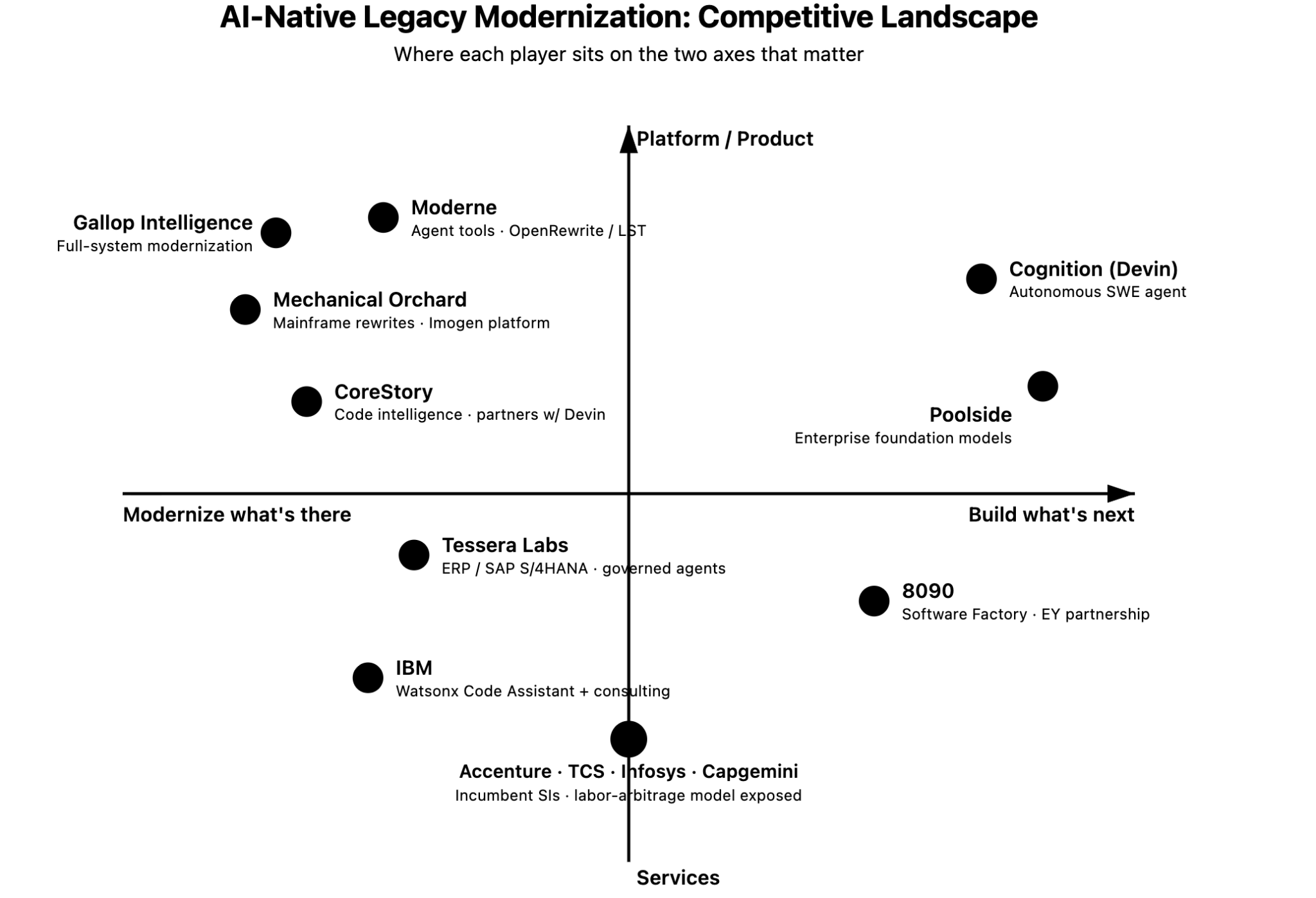
The established players mentioned in the image above have collectively staked out mainframe, ERP, agent tooling, and regulated-enterprise software factories. But there is still whitespace for new entrants. Below are some areas I’m particularly bullish about.
Post-mainframe, pre-cloud enterprise systems. Two decades of custom enterprise software built on Microsoft, Oracle, and open-source stacks. These systems run inventory, claims, distributor management, financial modules, and a long tail of back-office workflows at Fortune 500-1000 companies. The opportunity is around a full-system modernization that addresses application logic, the data layer (stored procedures, ETL, batch jobs), and integrations.
Vertical-specific modernization where deep regulatory expertise is needed, such as in healthcare, defense, manufacturing OT/IT convergence, energy, and telecom. Each has its own legacy stack and compliance requirements, so domain depth is important.
The mid-market tier, where projects run $150K–$2M rather than tens of millions, is large, fragmented, and underserved. AI changes the unit economics enough that a product-led motion could work well here.
Continuous-modernization platforms. United’s modernization efforts started in 2016, and they’re still not done a decade later. These initiatives can now happen much faster than before, but even a new system will become outdated within a certain number of years. A platform built for continuous modernization is more interesting than one built for a single mainframe-to-cloud migration. In other words, this is like an always-on layer that maintains a living map of the enterprise’s business logic, which can be re-translated onto whatever stack comes next.
Non-code legacy systems like ETL pipelines, EDI integrations, batch schedules, message queues, and undocumented processes. Most modernization efforts are around application code, but that’s just one layer of a legacy system. The infrastructure that actually encodes business logic is equally important and has often been overlooked. AI is uniquely suited to help here.
The only way you grow
In the Stratechery interview, Scott Kirby said: “The biggest mistake most people make in their careers is never making big mistakes. It’s the only way you grow. You have to decide, and not deciding on the status quo is a decision in itself.”
For a decade, the status quo on modernization (aka do nothing) was defensible because the alternative was an expensive, decade-long overhaul with no clear ROI. AI has changed that.
The companies that do nothing now are still making a decision, they just may not realize it yet. There’s an opportunity to build the platform that helps them see it, and gives them a credible path forward.
Author’s note: An LLM was used for light copy editing only (spelling, grammar, and clarity). Content, meaning, tone, and structure remain unchanged.